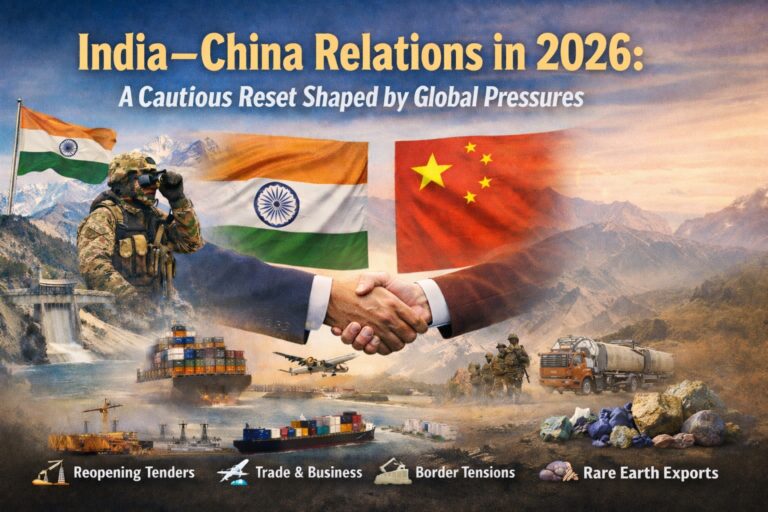
As of January 2026, the relationship between India and China is entering a phase best described as a cautious reset — economic pragmatism is advancing, even as strategic and security frictions remain unresolved. The shift is not warmth; it is calibrated transactionality, driven as much by external pressure as by bilateral choice.
1. Economic Thaw: Reopening Government Tenders
India has begun rolling back post-2020 restrictions that required Chinese firms to obtain special security clearances for government contracts. Chinese companies are gradually being allowed back into large public tenders, potentially unlocking infrastructure and power projects worth $700+ billion.
The trigger is operational, not political. Persistent supply shortages and execution delays — especially in the thermal power sector — have forced a reassessment. Indian EPC majors are already factoring in renewed competition, and investor concerns around margins and pricing power are visible in the numbers.
The signal: economic efficiency is taking precedence over blanket exclusion.
2. Trade and Business: Removing Friction Points
To operationalise recent leadership-level understandings, several commercial bottlenecks are being eased:
- Direct flights have resumed and business visas for Chinese professionals are now being cleared in roughly four weeks
- At Indusfood 2026, Chinese companies formed the largest foreign delegation at the Greater Noida expo, showcasing India-specific localised products
- China has lifted restrictions on rare earths and tunnel-boring machinery — both critical inputs for India's manufacturing and infrastructure ambitions
The signal: selective economic interdependence is being rebuilt — deliberately, sector by sector.
3. The "Trump Factor" and External Pressure
A major catalyst behind this tactical rapprochement is pressure from the United States. Tariffs of up to 50% on Indian and Chinese exports have already reshaped trade calculus, and a bipartisan US proposal threatens 500% tariffs on countries continuing Russian oil purchases — explicitly naming India and China.
The result is straightforward: both countries are incentivised to stabilise bilateral ties to avoid multi-front economic and strategic stress.
This is not normalisation. Border tensions, technology controls, and security frictions remain unresolved. The reset is transactional and sector-specific — and businesses should treat it that way when planning sourcing, partnerships, or capital deployment.
India–China relations in 2026 are neither friendly nor frozen — they are transactional, selective, and driven by global realignments rather than mutual trust. That changes how businesses should think about exposure, not whether to engage.
What This Means for Businesses, Investors, and Policymakers
This phase demands clear-eyed risk assessment, sector-specific opportunity mapping, and strategic hedging rather than overexposure. Geopolitical intelligence is no longer optional — it is a core input to capital allocation, supply-chain strategy, and long-term growth planning.
- The India–China relationship is in a cautious reset, not normalisation — drivers are pragmatism and external pressure
- Government tenders worth $700B+ may reopen to Chinese participation, with direct implications for Indian EPC competition
- Visa, aviation, and rare earth flows are being eased selectively — sector-specific, not blanket
- US tariff pressure is the primary external catalyst — both countries are stabilising ties to avoid multi-front stress
- Plan for transactional engagement with explicit hedging — overexposure is the wrong bet in a relationship still defined by frictions
For Indian and global businesses, the signal is not to retreat from China-linked supply chains — nor to lean in fully. It is to map exposure sector by sector, hedge deliberately, and treat geopolitical intelligence as a permanent input to capital allocation. The reset is real, but so are the frictions underneath it.
GCC advisory services India — for multinationals establishing Global Capability Centers as their primary India operating base.
India business set-up advisory — entity selection, regulatory filings, and local banking setup, end to end.
WOS vs LLP vs Branch vs Liaison Office: India Entry Structure Guide — if you are considering India as your new operating base, this is the structural decision that determines how well you can scale.